INFOCENTER
QYTeco is a professional solution provider for industrial inspection cameras and sewer drain cleaning machines.
Language
Contents🗂️
1. Why Spring Demands Immediate Pipeline Attention
2. Real-World Field Case Studies: Diagnostic to Resolution
✦Case Study 1: The Commercial Plaza Backflow Crisis
✦Case Study 2: The Residential "Greener Lawn" Mystery
3. 5 Industrial Indicators of Main Sewer Line Compromise
4. QYTeco Professional Systems: Engineering Specifications & Conversion Advantages
5. Proactive Preventative Maintenance for Professional Inspection Tools
✦Push Rod Care and Inspection
✦Control box cleaning
✦Optoelectronic Lens Maintenance
6. Frequently Asked Questions (FAQ)
Spring Sewer Line Inspection Masterclass: Real-World Case Studies & Advanced QYTeco Trenchless Solutions🕵️
As winter recedes, underground infrastructure undergoes its most volatile seasonal transition. Freezing temperatures, thawing soils, and aggressive botanical root systems converge to create hidden hazards within municipal, commercial, and residential sewer lines.
Conducting a comprehensive inspection in the spring is not merely routine maintenance; it is a critical, data-driven proactive strategy. In this masterclass, we will analyze real field case studies and demonstrate how choosing industrial-grade equipment like QYTeco can save thousands of dollars in destructive excavation costs.
1. Why Spring Demands Immediate Pipeline Attention⭐
📌Understanding why spring demands immediate pipeline attention requires a look at the physical and environmental stresses inflicted on underground networks during the colder months:
Thermal Expansion and Soil Shifting: As the frost line recedes, ground moisture fluctuates drastically. This natural thawing cycle causes significant ground movement, leading to soil misalignment and joint offsets in rigid pipe materials.
📌Aggressive Vernal Root Intrusion: In spring, tree roots wake up thirsty. Micro-fractures in sewer pipes release vapor and moisture into the soil, attracting root systems. Industry data shows that tree root intrusion accounts for approximately 50% of all severe sewer blockages.
📌Inflow and Infiltration (I&I) Overload: Spring rains and melting snow generate massive surface runoff, contributing up to 45% of the total annual water load entering compromised systems. This sudden volume surge converts minor winter cracks into catastrophic backflows.
2. Real-World Field Case Studies: Diagnostic to Resolution🔍
To understand the financial and operational impact of timely inspections, let us examine two real scenarios encountered by drainage contractors in the field.
The Challenge: A homeowner noticed an unusually lush, vibrant, and soft patch of grass in their front yard during late April. Concurrently, the household began hearing systemic pneumatic gurgling noises in the downstairs bathroom when the washing machine drained.
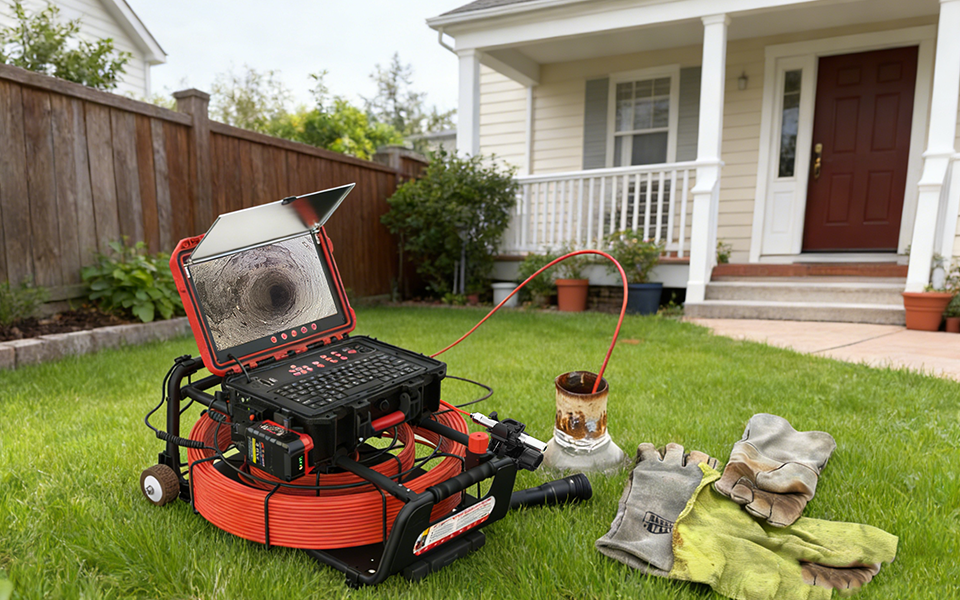
The Diagnostic: A technician utilized a QYTeco push rod inspection system. The camera captured a longitudinal structural crack along the top of the clay pipe. The lush grass was the direct result of nutrient-rich wastewater leaking into the soil matrix, while the gurgling was trapped air struggling past an localized root mass.
The Resolution: Early detection in the spring prevented a full mainline collapse. The line was cleared mechanically and reinforced before the peak water usage of summer, preventing a catastrophic raw sewage backup into the home.
The Challenge: A multi-tenant commercial building experienced sudden, recurring hydraulic backflows in the basement floor drains every time the spring rains intensified. Local plumbers attempted traditional cable snaking, but the blockage returned within 48 hours, threatening tenant operations.
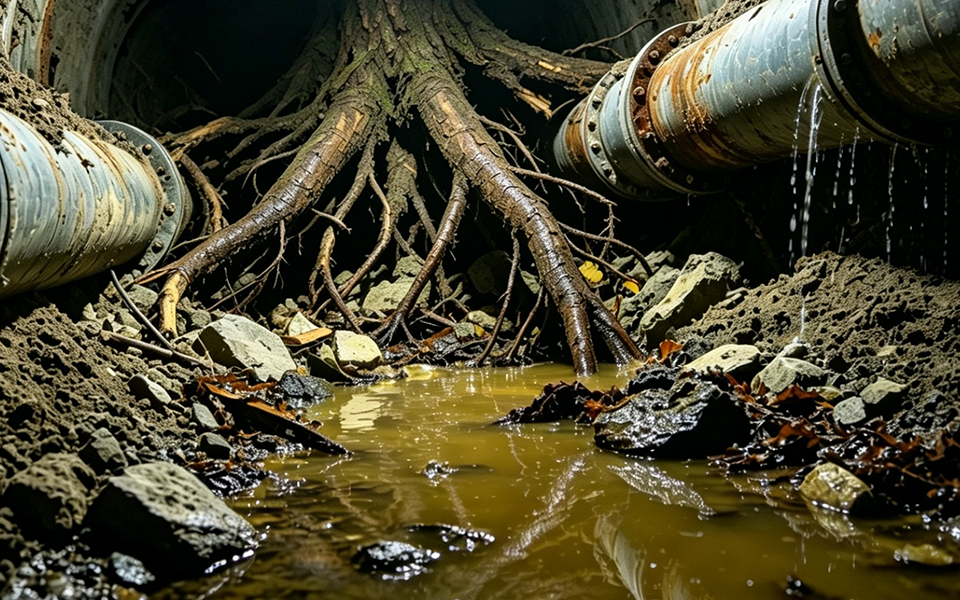
The Diagnostic: Contractors deployed the QYTeco QY6689D-31PT Pan-Tilt Sewer Drain Cameras into the 4-inch main line. At 42 feet, the high-definition 360° rotating lens revealed a severe joint offset caused by shifting spring soil, which had allowed massive willow tree roots to breach the line, catching grease and debris.
The Resolution: Instead of digging up the plaza’s newly paved parking lot (estimated at $12,000), operators used the camera's built-in 512Hz sonde transmitter to pinpoint the exact underground location. They deployed a high-speed mechanical cutter to grind away the roots and installed a trenchless pipe liner. Total savings: over $8,500.
3. 5 Industrial Indicators of Main Sewer Line Compromise 🎯
Property managers and engineering teams should watch for these five critical red flags before a complete system failure occurs:
Simultaneous Multi-Fixture Sluggishness: When toilets, floor drains, and sinks across an entire property exhibit synchronized slow drainage, the restriction is deep within the primary sewer mainline.
Systemic Pneumatic Gurgling: If flushing a toilet triggers distinct bubbling noises in adjacent shower basins, it indicates trapped air struggling past an underground obstruction.
Structural Odor Leakage: The unmistakable presence of airborne hydrogen sulfide ($H_2S$) within basements or yard areas points directly to an active pipe breach.
Anomalous Surface Vegetation Acceleration: Accelerated growth or saturated ground conditions in a localized turf area means an underground pipe rupture is actively leaking effluent.
Cross-Fixture Hydraulic Backflow: When high-volume water discharge causes immediate water backflow into lower-elevation entry points, the mainline capacity is severely compromised.
4. QYTeco Professional Systems: Engineering Specifications & Conversion Advantages 💪
When facing complex underground diagnostics, entry-level consumer tools or basic rental cameras fall short. QYTeco designs and manufactures industrial-grade pipeline inspection and cleaning equipment engineered for maximum durability, precision, and efficiency.
To ensure professional consistency and peerless performance in the field, every QYTeco sewer drain camera system integrates the following core technical highlights:
🏆 HD Pan-Tilt Camera System: Delivers continuous 360° rotation and 210° tilt visibility, capturing high-contrast internal topography to ensure micro-fractures and offset joints are fully documented.
🏆 Fiberglass Push Rod Cable: Offers a specialized composite formulation that balances high structural rigidity for long-distance pushing with the necessary flexibility to seamlessly navigate multiple 90° bends.
🏆 High-Speed Flexible Shaft Mechanism: Utilizes an industrial-grade internal core engineered to withstand high torque, delivering rapid rotational force to carbide-tipped cutters for immediate root and scale removal.
🏆 Multi-Language Operating System: Features an intuitive, localized digital user interface that ensures seamless operation, error-free diagnostics, and precise data logging across diverse international engineering teams.
🏆 Li-ion Battery Power Supply: Built on an advanced, high-capacity lithium-ion architecture to provide stable, long-duration operational power for remote field environments lacking access to grid power.
🏆 High-stability Pan-tilt Camera: Employ a more robust and stable internal physical structure design, making it more impact-resistant and stable. This addresses current industry challenges such as equipment fragility, difficulties in constructing with curved pipes, and low cost-effectiveness.
| WHY CHOOSE QYTECO? | |
| Feature | Business Benefit |
🥇 Dual Detection & Cleaning Lines 🥇 Built-in 512Hz Sonde Transmitter 🥇 Industrial IP68 Waterproofing | 🥇 One-stop workflow, higher efficiency 🥇 Zero guesswork, eliminates blind digging 🥇 Long equipment lifespan, low maintenance |
Client case study videos
5. Proactive Preventative Maintenance for Professional Inspection Tools 🔧
To maintain field accuracy and maximize the service life of high-end diagnostic systems, engineering crews must adhere to a strict post-operational maintenance protocol:
Push Rod Care and Inspection
Following every deployment, the fiberglass push rod must be wiped down with a clean cloth to remove abrasive grit and corrosive chemical residues. Inspect the entire length of the cable sheath weekly for superficial cuts that could impair future pushing capability.
Control box cleaning
The equipment operates in various work environments over a long period, and the surface of the control box, keyboard, and top cover are prone to accumulating dust, liquid splashes, dirt, or grime. Wipe the outer casing, keyboard, and top cover (excluding the screen area) gently with a small amount of alcohol, soapy water, or diluted disinfectant. For the screen, simply wipe it with a wrung-out damp paper towel or a soft cloth moistened with water. Always disconnect the power before cleaning to prevent liquid from seeping into the interior and causing a safety hazard.
Optoelectronic Lens Maintenance
The exterior sapphire glass lens cover must be kept clean to ensure crystal-clear video diagnostics. Clean the lens using a soft microfiber cloth and specialized optical cleaning solutions. Avoid harsh chemical solvents that can degrade surrounding waterproof bonding adhesives.
6. Frequently Asked Questions (FAQ) ❓
Q1: Can QYTeco cameras locate the exact position of a pipe leak from above ground?
Yes. QYTeco inspection cameras feature an integrated 512Hz sonde transmitter inside the camera head. When deployed underground, the camera emits a continuous frequency that can be accurately tracked from the surface using a 512Hz locator receiver, pinpointing both the exact location and depth of the pipe defect.
Q2: Why is investing in a QYTeco system more cost-effective than hiring a standard plumbing service?
Hiring a commercial plumbing contractor for diagnostic imaging typically costs between $300 and $800 per visit. For property managers, municipalities, and professional contractors, purchasing a dedicated QYTeco system pays for itself within just a few deployments, while granting 24/7 on-demand inspection capabilities.
Q3: What should I do if the camera reveals a heavy root intrusion?
If the inspection reveals heavy root systems clogging the pipe, a traditional drain snake will only punch a temporary hole. It is recommended to deploy a QYTeco high-speed flexible shaft cleaning machine equipped with expanding chain cutters. This completely clears the root mass back to the pipe walls, preparing the line for long-term trenchless rehabilitation or pipe lining.

Manufacturer and supplier of HD sewer drain pipe CCTV inspection camera system, flex shaft cleaning machines, trenchless equipment, cavity wall inspection camera tool, rigid/flexible articulating borescopes, barrel borescopes, HD videoscopes, endoscopes.