Buying Guides & Application Insights
QYTeco is a professional solution provider for industrial inspection cameras and sewer drain cleaning machines.
Language
QYTeco is a professional solution provider for industrial inspection cameras and sewer drain cleaning machines.
If you actively follow the plumbing and maintenance industry, you have likely read recent trending news regarding drain cleaning equipment, drain cleaning tools, and the latest sewer cleaning machine developments. Looking closely at the top 5 recent industry reports, you will notice a heavy emphasis on macro-level market growth, municipal infrastructure investments, and the adoption of massive high-pressure jetting trucks. However, as a pipeline dredging author who evaluates these tools daily, I noticed a glaring omission in these reports. They rarely discuss the micro-level advancements that actually impact the daily lives of plumbing technicians: the evolution of user experience, cord-free mobility, and the practical mechanics of chain knockers.
In my experience, the industry focuses too heavily on raw power rather than the finesse required to protect aging pipes while working efficiently. We need to shift the conversation toward practical, field-ready innovations. I believe the true future of this industry lies in cordless, battery-operated efficiency, freeing technicians from the endless search for a power outlet in damp basements. Choosing the right sewer drain cleaning setup requires looking past the surface-level marketing and understanding how modern engineering translates into tangible on-the-job benefits.
The Shift Toward High-End, Cordless Drain Cleaning Machines
Historically, technicians relied on heavy, corded drum machines that required direct access to electrical outlets. Today, the landscape of drain cleaning equipment has fundamentally changed. The modern drain cleaning machine utilizes advanced brushless motors and high-capacity batteries. This cordless design means technicians no longer need to drag heavy extension cords through a client's home or worry about finding a reliable power source in remote or unfinished locations. You can carry the tool into an attic, a crawlspace, or a rooftop and begin working immediately.
When evaluating these tools for a B2B purchasing decision, you must look at how specific features elevate a basic drain cleaning tool into a high-end, human-centric device. For example, modern units feature an E-stop (Emergency Stop) button, which instantly halts the machine if the cable binds, significantly reducing the risk of injury or pipe damage. Additionally, features like forward and reverse chain rotation allow technicians to navigate complex bends and clear stubborn scale effectively. Variable RPM (Revolutions Per Minute) adjustment gives the user precise control, ensuring they apply the right amount of friction for fragile PVC pipes versus durable cast iron pipes.
The QYTeco drain cleaning tool perfectly exemplifies this technological shift. By integrating a brushless motor, intuitive RPM controls, and a strict focus on battery-powered portability, QYTeco transforms a traditionally labor-intensive task into a seamless, highly controlled operation. These features provide a superior user experience, lowering the learning curve for new technicians and speeding up job completion times for seasoned professionals.
Maximizing Efficiency with an All-In-One Dual System
To truly understand how to choose the best equipment, we must look at how different tools interact on the job site. Traditionally, a technician would use a sewer camera to inspect the line, pull the camera out, run a drain cleaning machine to clear the blockage, and then re-insert the camera to verify the work. This constant switching wastes valuable time.
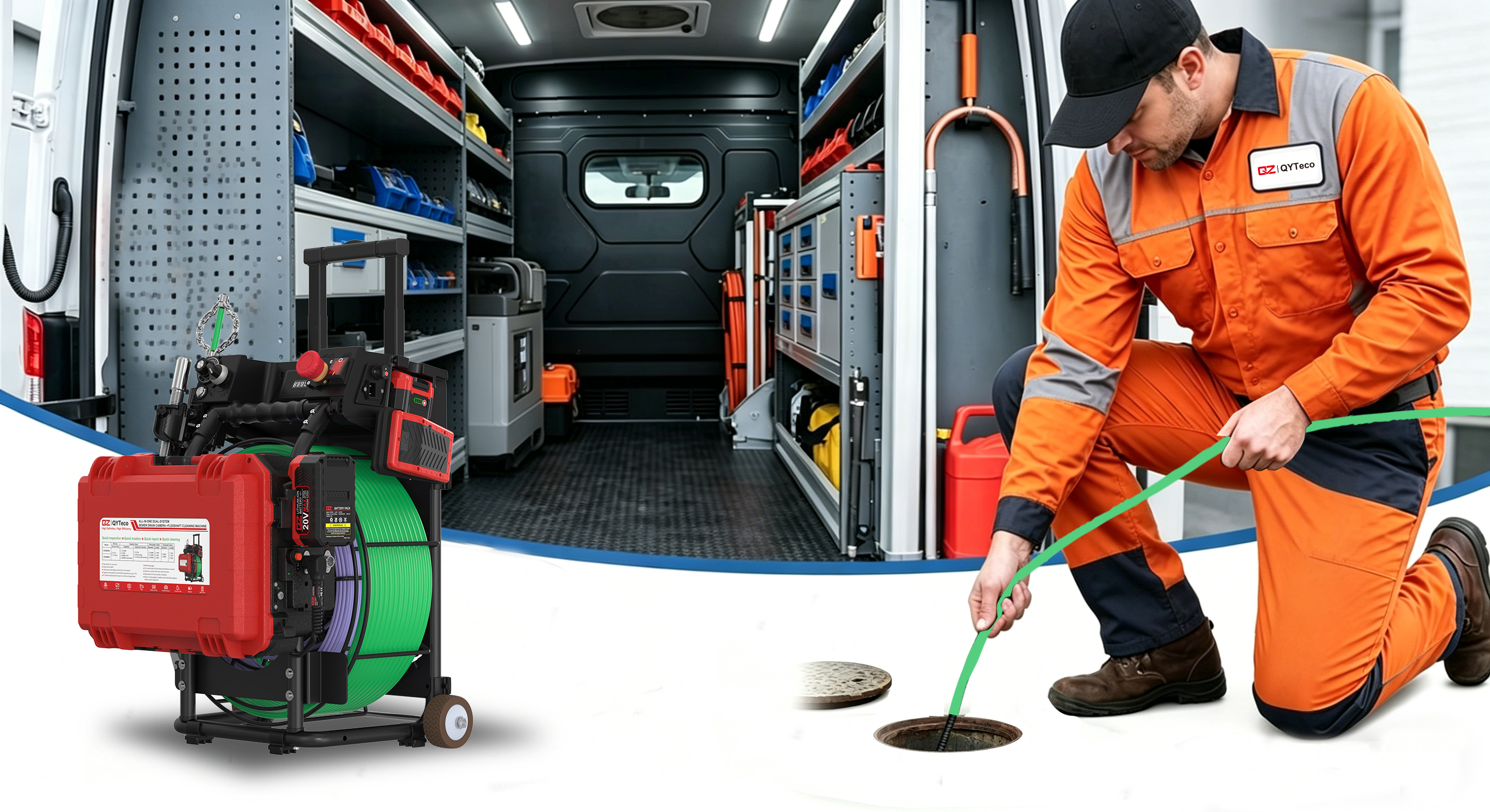
The modern approach integrates these technologies. An All-In-One Dual System: Drain Camera + drain Cleaning Machine is an advanced, all-in-one solution for drain maintenance, combining HD video drain inspection for real-time pipeline diagnostics and High-speed drain cleaning with a waterless flexible shaft cleaning mechanism in a single compact unit, enabling simultaneous inspection and cleaning. Its compact design enhances operational efficiency, reducing downtime and machine requirements.
By utilizing this integrated approach, plumbing businesses can significantly increase their daily service call capacity. I often find that carrying separate inspection and cleaning units wastes valuable setup time; an integrated system completely changes the workflow efficiency. Technicians can watch the chain knocker obliterate tree roots and descale pipe walls in real-time on the monitor. This visual feedback ensures that they clean the pipe thoroughly on the first pass, drastically reducing the chances of a costly callback from a dissatisfied client.
Real-World Applications and the Power of Brushless Motors
When deploying a sewer cleaning machine in the field, stability and reliability are paramount. The integration of brushless motor technology provides a distinct advantage here. Unlike traditional brushed motors, brushless motors generate less friction, produce less heat, and offer a much more consistent torque curve. This means that when the chain knocker hits a dense blockage, the motor does not stall or overheat; it intelligently draws the necessary power from the battery to maintain rotation. This objective, stable power delivery extends the lifespan of the equipment and reduces maintenance overhead for plumbing businesses.
Versatility is another critical factor. Designed for both scheduled maintenance and emergency interventions, it is ideal for addressing blockages or damage in kitchen/bathroom drains, drainpipes, and downspouts to restore or maintain optimal pipe functionality. Its internal reel is equipped with a 12.8mm, 21mm or 29mm camera head as an option, suitable for 1.2''-6.5'' (DN32-165mm) pipeline inspection, and the external flexible shaft cable is equipped with a different chain knocker, suitable for 1.5''-4'' (DN32-100 mm) pipeline dredging.
From a practical standpoint, having interchangeable camera heads and adjustable chain knockers prevents technicians from turning down jobs due to incompatible pipe diameters. You can transition from clearing a delicate 1.5-inch kitchen sink drain to descaling a robust 4-inch main sewer line using the exact same base unit, simply by swapping the attachments.
Addressing the Missing Details: Chains, Safety, and Maintenance
Returning to the gap in recent industry news, we must discuss the physical components doing the actual work inside the pipe. News reports frequently mention "high-speed cleaning" but rarely discuss chain selection, chain thickness, safety protocols, and the ongoing maintenance of drain cleaning equipment.
Choosing the correct chain knocker is vital. Standard chains work well for soft blockages and light descaling, while carbide-tipped chains are necessary for aggressive root cutting and removing heavy cast-iron scale. The thickness of the chain also matters. A 3mm chain offers the flexibility needed for navigating tight P-traps in smaller domestic lines, whereas a 4mm or thicker chain provides the mass and centrifugal force required to scour larger municipal or commercial pipes. Using an oversized chain in a small pipe can cause severe damage, while using an undersized chain in a large pipe yields poor cleaning results.
Safety during operation relies heavily on the protective sheath surrounding the flexible shaft. This sheath remains stationary while the inner core spins at high speeds, allowing the technician to hold the cable safely during operation. Technicians must strictly utilize the E-stop button and RPM dials to maintain safe operational speeds, especially when transitioning between different pipe materials.
Finally, the longevity of your drain cleaning tools depends entirely on proper maintenance. Flexible shafts require regular care. After completing a job, technicians must extract the cable, wipe away moisture and debris, and apply a specialized rust-inhibitor or lubricant to the inner core. Similarly, the sewer camera lens and LED rings must be cleaned with non-abrasive solutions to maintain clear visibility. By establishing a strict maintenance routine, plumbing professionals can protect their investment and ensure their equipment performs flawlessly during emergency service calls.
Conclusion
You need reliable drain cleaning equipment to maintain pipes efficiently. Choose a modern drain cleaning machine with a brushless motor, battery power, and an integrated sewer camera. These tools reduce setup time, increase safety, and improve your diagnostic accuracy. Invest in versatile equipment to handle any plumbing challenge effortlessly.
FAQ About Drain Cleaning Tools
1. How do battery-powered drain cleaning tools improve safety?
Battery-powered tools eliminate electrical cords in wet environments. This design removes tripping hazards and significantly reduces the risk of electric shock while you work.
2. Why should I choose a machine with a brushless motor?
Brushless motors run cooler and last longer than traditional motors. They provide consistent power to your drain cleaning tools without requiring regular brush replacements.
3. How do I maintain my flexible shaft drain cleaning equipment?
You must clean and lubricate the flexible shaft after every use. Wipe down the cable, apply a suitable rust inhibitor, and store the machine in a dry place.
4. What does the E-stop button do on a drain cleaning machine?
The E-stop button instantly cuts power to the motor. You press this button to stop the spinning cable immediately if it binds or catches inside the pipe.

Manufacturer and supplier of HD sewer drain pipe CCTV inspection camera system, flex shaft cleaning machines, trenchless equipment, cavity wall inspection camera tool, rigid/flexible articulating borescopes, barrel borescopes, HD videoscopes, endoscopes.